Getting Married in Italy: The Complete Guide for UK Couples
Veilly Team
Getting married in Italy is the most popular destination wedding choice for British couples — roughly a quarter of all foreign couples marrying there come from the UK. Before you book that villa you found on Pinterest, though, three things will genuinely shape your wedding: the paperwork (the most demanding in Europe), the real budget, and your choice of region. This guide walks you through all three, in order.
Key takeaways
- More than 15,000 foreign couples marry in Italy every year, and British couples are the largest group. Tuscany is the most chosen region, ahead of Lombardy (Lake Como) and Campania (the Amalfi Coast).
- A legal civil wedding on site is possible, but it requires an apostilled CNI and a statutory declaration, and the realistic buffer for the paperwork is around six months. That's why most UK couples marry legally in England and hold a symbolic ceremony in Italy — the standard here, not a compromise.
- A realistic premium budget for 70 to 90 guests runs €40,000 to €60,000 in Tuscany, Puglia and Sicily, and €60,000 to €100,000 or more on Lake Como and the Amalfi Coast. The date alone can halve the price: the same wedding costs €35,000 to €50,000 on a Thursday in May and €65,000 to €85,000 on a Saturday in July.
- The best weather windows are May to June and September to early October. July and August mean temperatures above 30°C, crowds and peak pricing.
- Venue availability, not paperwork, sets your planning timeline: the most sought-after villas in peak season are booked eighteen to twenty-four months ahead.
Why Italy?
No other country offers this much variety on one passport: stone villas among vineyards, lakes with belle époque glamour, cliffs above turquoise water, whitewashed masserie in olive groves and the baroque towns of Sicily. Add food your guests will talk about for years, and logistics kinder than the prestige suggests: London to Pisa takes around two hours ten minutes, Naples two hours forty, Bari just under three, with routes served from regional airports like Manchester and Edinburgh too. Italy is not, however, the place for couples who want the simplest legal path or the lowest budget — Croatia and Portugal do that better. You choose Italy for the aesthetics and the experience, and accept a little more planning in return.
How to get married in Italy as a UK couple
The legal side is the most common source of confusion, so let's take it apart properly. Italy has no residency requirement, but the document process is the most involved of any popular destination.
What documents do you need for a civil wedding?
Each of you needs a certificate of no impediment (CNI) — the official confirmation that nothing stands in the way of your marriage — issued by your local register office in the UK after the statutory 28-day notice period. The CNI must then be legalised by the FCDO with an apostille, the international certification stamp. On top of that comes a bilingual statutory declaration, signed before a solicitor or notary public and apostilled as well. Watch the validity windows: a CNI issued in England, Wales or Northern Ireland is valid for six months, a Scottish one for only three — so the documents can't be prepared far in advance and have to be timed backwards from your wedding date.
How long does the paperwork really take?
In theory the process can be completed in six to eight weeks, but in practice the FCDO's standard postal service can take several weeks on its own, and any error in the documents sends you back to the start. The realistic safety margin is around six months. The paradox is that because of the CNI's limited validity, you actually start the paperwork only a few months before the wedding — long after you've booked the venue.
Civil wedding or symbolic ceremony?
Most British couples take a third route: a civil marriage in England a few weeks before travelling, followed by a full-scale symbolic ceremony in Italy led by a celebrant. You gain complete freedom over the setting (a villa terrace instead of a room at the comune), the timing and the script, and the paperwork disappears entirely. Guests usually never notice the difference. A Catholic church wedding is possible and carries civil effect, but it runs through a separate track via your UK parish and the diocese — allow at least six months for the church formalities alone.
Same-sex couples: what you need to know
Italy does not recognise same-sex marriage. Since 2016 it offers civil unions (unioni civili), which carry most of the rights of marriage, and a British same-sex marriage is treated in Italy as a civil union. In practice, same-sex couples from the UK almost always marry legally in England and hold a symbolic ceremony in Italy — venues and planners across the destination regions are entirely at home with this.
How much does a wedding in Italy cost?
For a premium wedding of 70 to 90 guests, the realistic range is €40,000 to €60,000 in Tuscany, with Puglia and Sicily starting somewhat lower, and €60,000 to €100,000 or more on Lake Como and the Amalfi Coast, where prices at the top villas have risen sharply over recent seasons. Catering alone in Tuscany typically runs €130 to €220 per head for a full Italian menu with wine and an open bar. Then come venue hire (from €5,000 to €8,000 for an agriturismo to €30,000 and beyond for iconic villas on an exclusive basis), photography and film, flowers and coordination.
Two things surprise UK couples most. First, the power of the date: the same wedding can cost €35,000 to €50,000 on a Thursday in May and €65,000 to €85,000 on a Saturday in July. If your guests are flying in for the whole weekend anyway, a Friday ceremony instead of Saturday is the easiest saving you'll find. Second, exclusive-use costs: many Italian villas require you to take the whole property for several days, which raises the budget but also gives you accommodation for part of your guest list and a stage for the entire weekend. Compared with a premium wedding in the UK, where a single Saturday at a country house can cost as much as three days at a Tuscan villa, Italy simply gives you more for the same money.
When to go: the weather month by month
Italy's wedding season runs from May to mid-October, and the vast majority of weddings happen inside that window. May and June bring 20 to 25°C, green landscapes and ideal conditions for a late-afternoon outdoor ceremony. July and August mean 28 to 35°C — more in the south — plus peak prices and crowds; if midsummer is your only option, plan the ceremony after 5pm and give guests shade, water and fans. September is, for many planners, the best month of the year: still warm, the finest golden light, and harvest time in the wine regions. October works beautifully in the south — Sicily and the Amalfi Coast hold beach weather longer than the north — though Como turns cool and some seasonal infrastructure winds down. April is the underrated option for the south: mild temperatures, lower prices, fewer tourists. Winter only makes sense for a fully indoor celebration.
Which region should you choose?
This is the biggest decision after the date itself — the regions differ not just in scenery but in budget, travel logistics and the kind of venue you'll find. Here are the five that UK couples choose most.
Tuscany
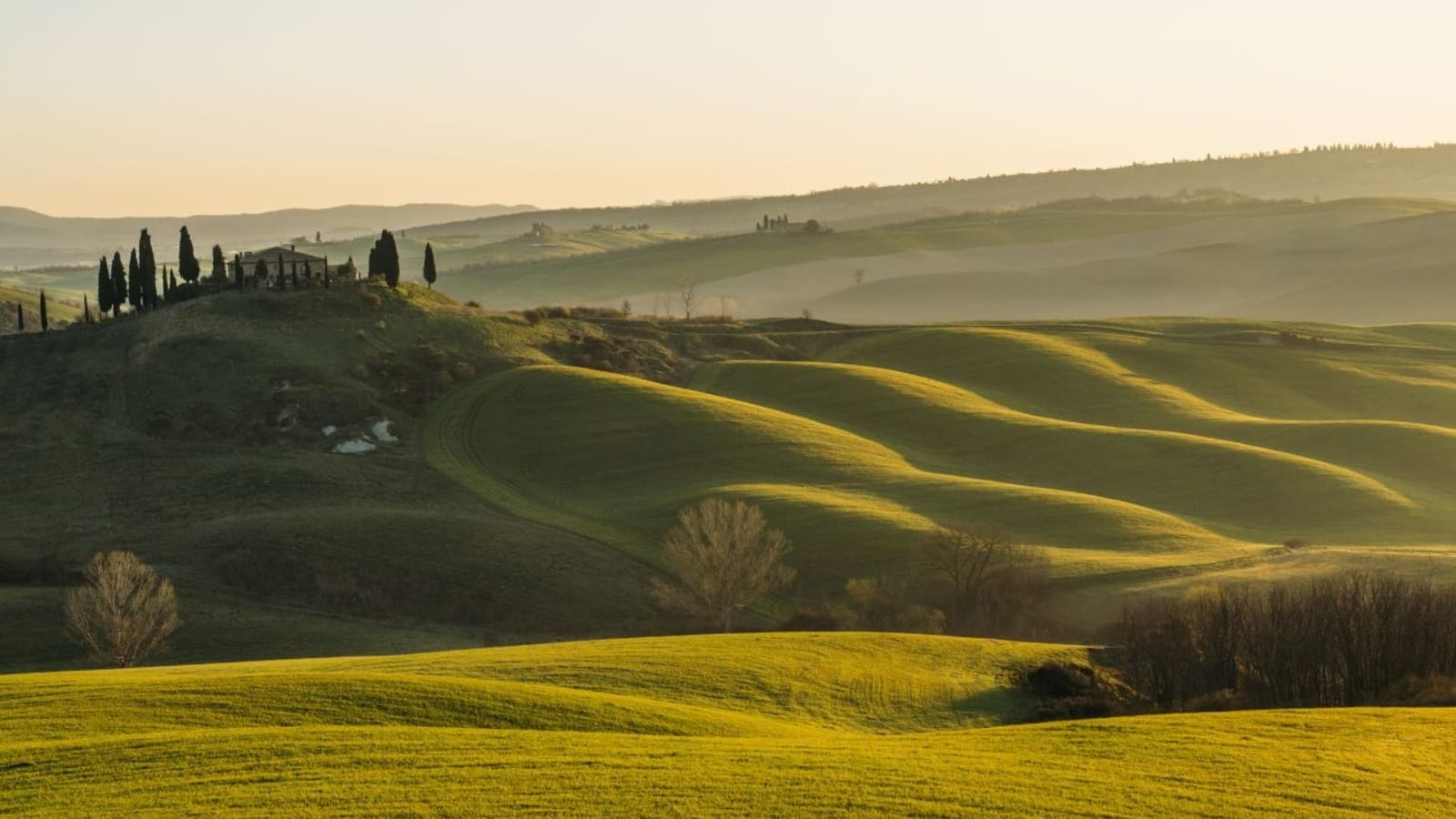
The classic, and still number one: around 21 per cent of foreign couples marry here. Stone borghi, vineyards, cypress-lined drives and the widest venue choice in the country — from agriturismi at sensible prices to estates like the Ferragamo family's Il Borro, Villa Cetinale and Borgo Stomennano. Fly to Pisa or Florence (around two hours ten to two thirty from the UK), then transfer one to one and a half hours into the region. Budget for 70 to 80 guests: usually €40,000 to €60,000. Top Saturdays book twelve to eighteen months out. The safest choice if you want premium without risk.
Lake Como
Prestige in its purest form, and the most expensive address on this list. Villas like Balbianello, Regina Teodolinda and the castle of Rossino host smaller celebrations — Como rewards shorter guest lists and larger budgets (€60,000 to €100,000 and up). Fly to Milan (around two hours), then transfer one to one and a half hours to the lake. The iconic villas can be booked twenty-four to thirty months ahead for peak season; if Como is the dream, plan a two-year runway. Late May and early October give you the same light without the tour-boat traffic.
The Amalfi Coast
Dramatic cliffs, Positano, and Ravello terraces that cannot be replicated — Villa Cimbrone and Hotel Caruso are among the most coveted wedding settings in the world. The price of that backdrop: budgets on a par with Como, and a transfer you should flag honestly to guests — from Naples (two hours forty from London) it's a winding one-and-a-half to two-hour drive. Book eighteen months or more ahead. Best months: June and September; July and August mean full sun on the ceremony and crowded towns.
Puglia
The fastest-growing choice for couples who want Italy without northern Italian prices: whitewashed masserie in olive groves (the cult-favourite Masseria Moroseta, the luxurious Borgo Egnazia), the sea, and the best value on this list. Fly to Bari in around two hours fifty, with the airport close to most venues. Budgets for 80 to 100 guests start noticeably lower than Tuscany, though the top masserie are catching up with the north. Book twelve months or more ahead — demand grows every season.
Sicily
The most cinematic and most distinctive region: baroque Noto, Taormina with Mount Etna behind it, clifftop tonnare like Tonnara di Scopello and villas in the style of Villa Elena. The season runs longer than anywhere else — beach weather into October — and prices sit closer to Puglia than Como. Flights to Palermo or Catania are partly seasonal and sometimes involve a connection, the one logistical drawback for guests. For couples who want character and authenticity rather than the obvious postcard.
How to decide? If you want certainty and choice, Tuscany. If prestige and intimacy, and budget isn't the constraint, Como or Amalfi. If value, space for a bigger group and a whole weekend in one place, Puglia. If character and a longer season, Sicily.
Italian wedding customs that surprise UK guests
An Italian wedding runs on a different rhythm from a British one, and it's worth warning your guests before they start asking when the speeches are. The wedding dinner is the heart of the day: a standing aperitivo, antipasti, one or two primi, a secondo, sorbet, cake and espresso — the whole thing can run four to five hours, with long pauses between courses that are there for conversation, not because anything is late. Speeches are not part of Italian tradition — if you want the classic British order (father of the bride, groom, best man), you'll need to plan it with your caterer in advance and specify exactly which courses the toasts fall between. Otherwise the kitchen will simply keep serving.
Some local traditions are worth adopting outright: confetti, sugared almonds given to guests in odd numbers (five stand for health, wealth, happiness, fertility and long life) in decorative bomboniere; the tarantella on the dancefloor; and in the south the serenata, a night-time serenade beneath the bride's window before the wedding. When working with local vendors, adjust to the Italian style of communication: things happen at the right moment, not necessarily the moment in the email thread, and dietary requirements and a speech schedule need to be spelled out explicitly — Italian wedding kitchens treat both differently than British ones do.
Guest logistics: the hardest part nobody warns you about
Picture it: 80 guests from the UK, Ireland and Australia, three villas and a hotel within twenty minutes of the venue, transfers from two different airports, a welcome dinner on Friday, the ceremony on Saturday, a farewell brunch on Sunday. Every guest needs to know where they're sleeping, who's picking them up, what time to arrive and what to wear in 30-degree heat. This is precisely the moment the WhatsApp group descends into chaos and you answer the transfer question for the fortieth time.
It's exactly what we built Veilly for: one private wedding website where every guest sees their room, their transfer and the full weekend schedule — no app, no registration, just a link from the invitation. You stop being the information desk, and the wedding feels as considered as the villa you chose, from the very first click.
Your planning timeline, step by step
Start eighteen to twenty-four months out if you're aiming for a top venue on Como, the Amalfi Coast or a peak-season Saturday in Tuscany; twelve to eighteen months is enough with more flexibility. In that window: book the venue and planner, choose a date with a weather plan B. Twelve months out: photographer, catering, music — the best local vendors disappear as fast as the villas. Nine to twelve months out: save-the-dates with travel information, so guests can plan leave and flights. Four to six months out: start the CNI paperwork (timing the documents' validity against your date) or hold your civil marriage in the UK; launch your wedding website with RSVP, accommodation and transfers. Two to three months out: RSVP deadline, assign guests to rooms and transfers, finalise the menu. The last month: vendor confirmations and the final-details message to guests — which, if everything has lived in one place from the start, largely sends itself.
Summary
Italy asks for more planning than Croatia or Portugal, but no other destination offers five such different weddings in one country — from a Tuscan vineyard to a tonnara on a Sicilian cliff. Make the big decisions in this order: region (it sets the budget and the character), date (it sets the price and the weather), venue (it sets the entire timeline). Leave the paperwork until later — and most likely handle it in England, as the majority of British couples do. And when the moment arrives when dozens of guests from several countries start asking the same questions about hotels, transfers and dress codes, remember that the answer doesn't have to be another WhatsApp group. It can be one elegant link.
Frequently asked questions
Here are the questions British couples ask most often when planning a wedding in Italy.
Can UK couples legally get married in Italy?
Yes. Italy has no residency requirement, but you'll need a CNI from your local register office (after the 28-day notice), an FCDO apostille and a bilingual statutory declaration. The CNI has a limited validity (six months for certificates issued in England and Wales, three for Scottish ones), and the realistic margin for the whole process is around six months. That's why most couples marry legally in England and hold a symbolic ceremony in Italy.
How much does a wedding in Italy cost for 80 guests?
The realistic premium range is €40,000 to €60,000 in Tuscany, Puglia or Sicily, and €60,000 to €100,000 or more on Lake Como and the Amalfi Coast. Catering alone typically runs €130 to €220 per head. The date matters enormously: the same wedding on a weekday in May can cost nearly half of what it does on a Saturday in July.
What is the best month to get married in Italy?
May, June and September offer the best balance of weather, light and price, with September adding golden light and the grape harvest. July and August mean heat above 30°C and peak prices. In Sicily and on the Amalfi Coast the season runs longer — October can still feel like summer.
How far in advance should we book a venue in Italy?
Twelve to eighteen months as standard. The iconic villas on Lake Como and the Amalfi Coast book eighteen to thirty months ahead for peak season. With a flexible date (a weekday, or shoulder season) six to twelve months can be realistic.
Do we need a wedding planner in Italy?
For a destination wedding of 70 or more guests, practically yes. A local planner knows the vendors, the language and the authorities, and with a multi-day format coordinates logistics you can't manage from London. Expect around 10 to 15 per cent of the budget, or a fixed fee.
Which region of Italy is best for a wedding?
Tuscany gives you the widest choice and the most certainty, Como and Amalfi the most prestige at the highest budgets, Puglia the best value for larger groups, and Sicily the most character and the longest season. In practice the decision comes down to budget, guest count and how far your guests are willing to travel from the airport.
Will our Italian wedding be recognised in the UK?
Yes — a civil marriage carried out under Italian law is recognised in the UK. For same-sex couples: Italy only offers civil unions, not marriage, which is why the standard route is a legal marriage in the UK followed by a symbolic ceremony in Italy.